If you’ve ever ordered branded merchandise and thought “that’s not quite the right colour,” you’re not alone. Colour inconsistency is one of the most common frustrations in branding and print. More often than not it comes down to one thing: using the wrong colour system for the job.
Here’s the good news. Once you understand the four main colour systems, it all starts to make a lot more sense.
First, the big split: Print vs. Screen
Before we get into the four systems, there’s one distinction worth locking in early.
Print and screen handle colour completely differently.
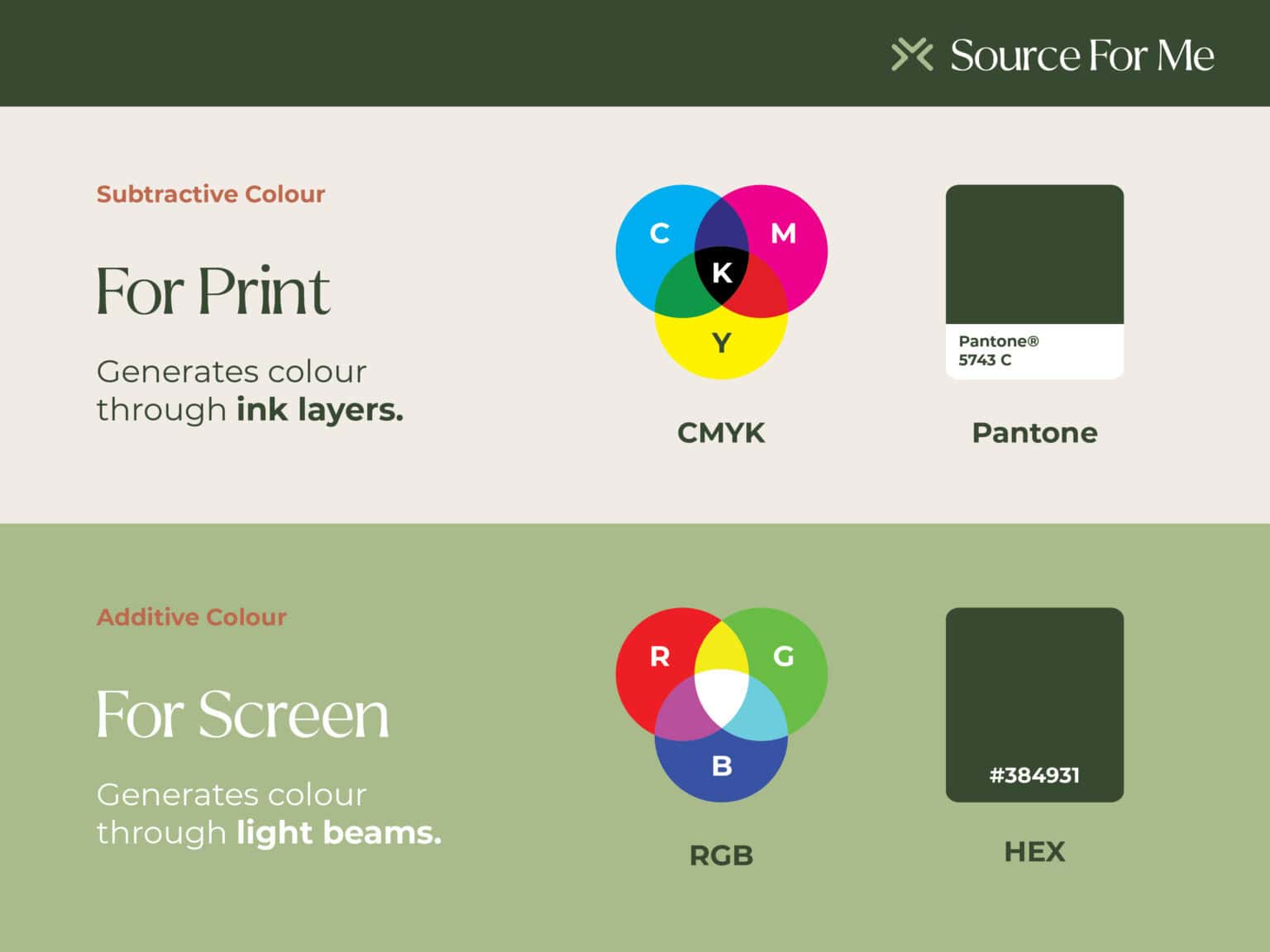
- Print colour is subtractive. Inks are layered on paper and absorb light. The more ink you add, the darker it gets.
- Screen colour is additive. Light is released directly from the display. Mix all colours together and you get white.
This is why a colour that looks vibrant on your laptop screen can look flat and dull once it’s printed, and why you can’t just use your website colours directly in a print file without some conversion work first.
Simple rule: Pantone and CMYK are for print. RGB and HEX are for screen.
Pantone (PMS)
Best for: Branded merchandise, Screen printing, Offset printing
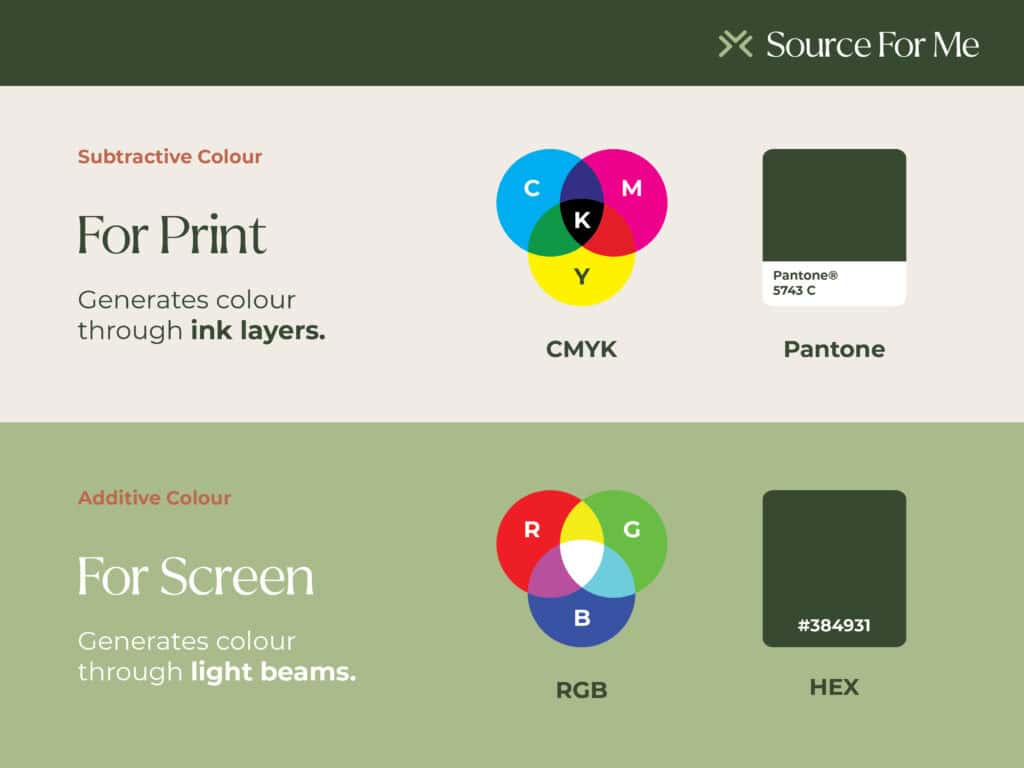
Pantone, or PMS (Pantone Matching System), is essentially the universal language of colour in the print and production world. Each Pantone colour has its own unique reference number and is produced as a pre-mixed ink, meaning no matter who’s printing your job or where in the world they are, Pantone 5743 C is always going to be Pantone 5743 C.
This is exactly why most brand guidelines include a Pantone reference for logo colours. It takes the guesswork out entirely.
When you’re ordering branded merchandise, you’ll often be asked for a Pantone reference. If you don’t have one, a good supplier will work with you to find the closest match, but having it locked in from the start means fewer surprises and a much more consistent result across different products and materials.
Worth noting: not every print method supports Pantone inks. It’s more commonly used in offset printing, so for high-volume, full-colour work like brochures and flyers, you’ll more likely be working in CMYK.
CMYK
Best for: Full-colour print, brochures, flyers, packaging, digital printing
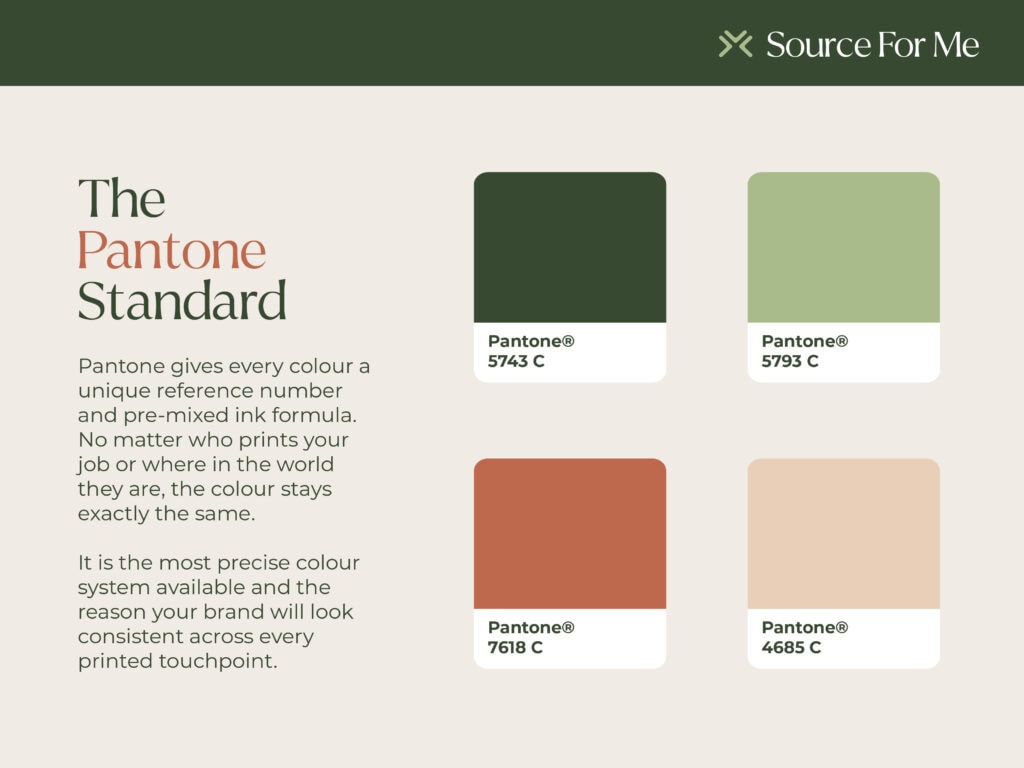
CMYK stands for Cyan, Magenta, Yellow and Key (Black). Rather than using a single pre-mixed ink like Pantone, CMYK printing layers tiny transparent dots of these four colours on top of each other to create a wide range of colours.
If you were to look at a CMYK-printed piece under a magnifying glass, you’d actually see those individual dots and how they overlap to produce the final colour. Pretty cool.
CMYK is the go-to for most full-colour commercial printing. It’s cost-effective, widely supported, and capable of producing a broad colour range. The trade-off is that it’s not as precise as Pantone. Two printers running the same CMYK file on different machines can produce slightly different results, which is why having a Pantone reference to check against is always a good idea for anything brand-critical.
One thing to always keep in mind: never supply a screen-based RGB or HEX file to a printer. Your artwork needs to be set up in CMYK from the start, otherwise the colour conversion the printer applies can throw things off in ways that are hard to predict.
RGB
Best for: Websites, digital ads, social media, screens of all kinds
RGB stands for Red, Green and Blue. It’s the colour system used by every screen you interact with, from your phone to your monitor to your TV.
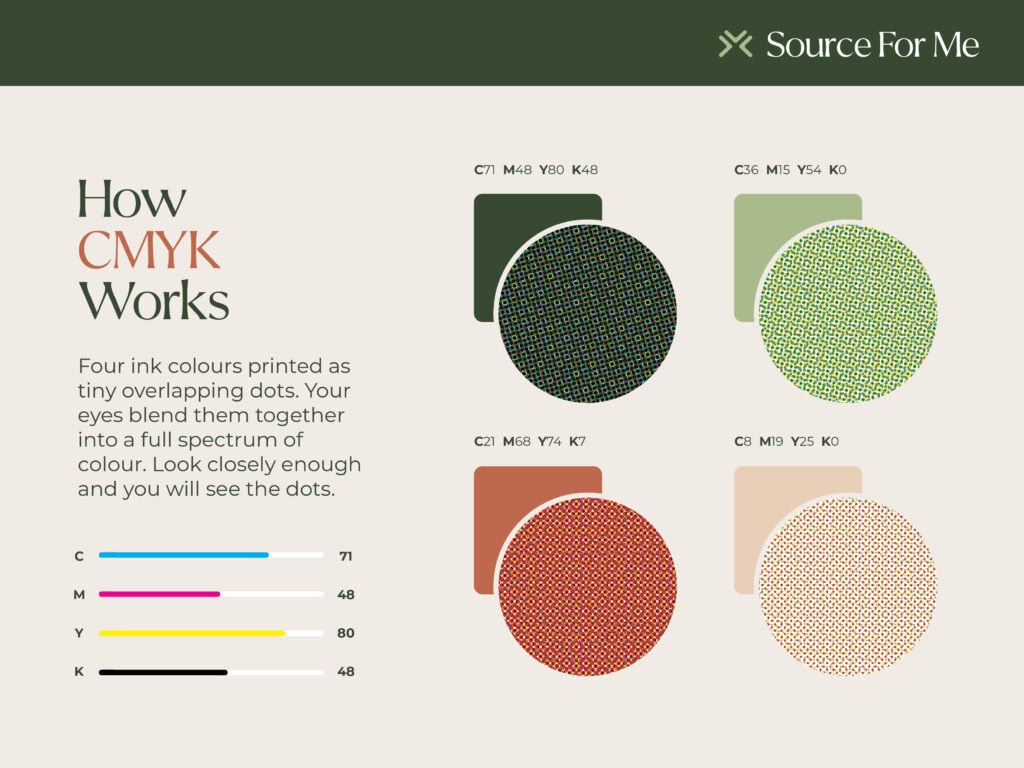
Unlike print, which absorbs light, screens release it. Combining red, green and blue light at full intensity produces white. Remove all three and you get black. This additive process is what gives RGB colours their distinctive vibrancy and glow.
It’s also what makes them look so different once printed. If you’ve ever printed something that looked amazing on screen and felt flat in real life, RGB is usually the reason. The range of colours a screen can display is simply larger than what ink on paper can reproduce.
RGB is the right choice for anything that lives exclusively on screen: social media graphics, email headers, website visuals, digital banners etc. Just remember to convert to CMYK before anything goes to print.
HEX
Best for: Web design, websites, digital applications
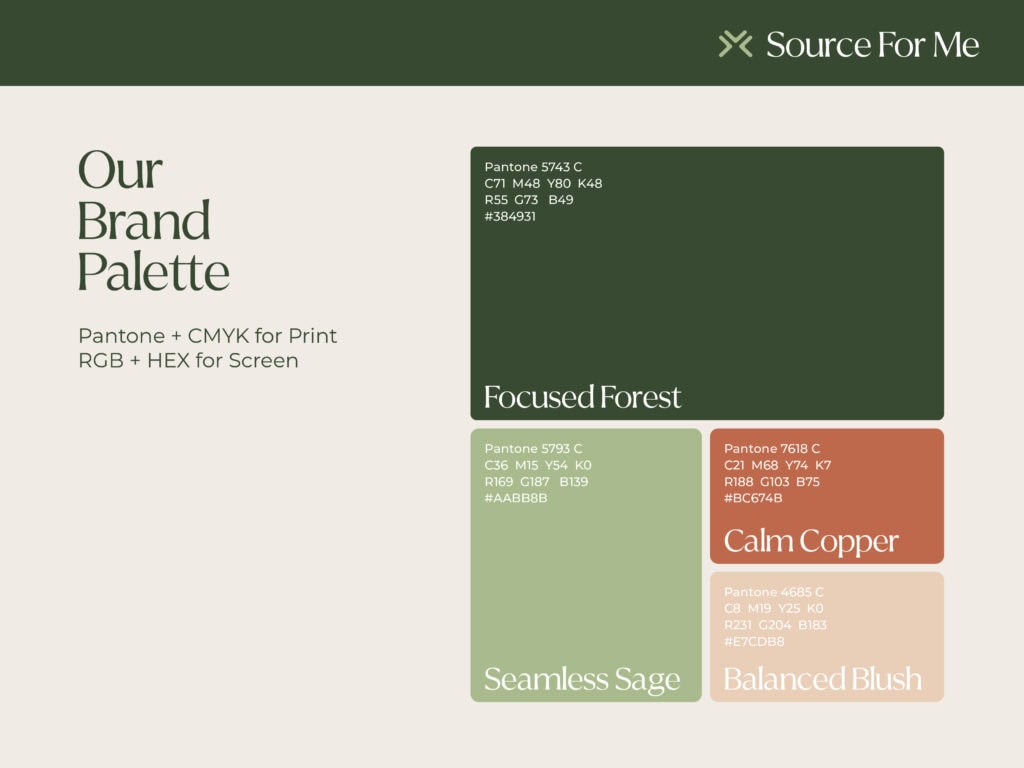
HEX codes are essentially a shorthand version of RGB, written in a format that web browsers and developers can read. A HEX code looks something like #384931 and is made up of six characters that correspond to the red, green and blue values of a colour.
If you have a web developer building or maintaining your website, HEX codes are what they’ll need. Most design software, including Adobe tools and Canva, will show you the HEX code alongside the RGB values, so it’s easy to grab and share.
You don’t need to understand the maths behind how HEX codes work. You just need to know that every colour in your brand should have one and your designer or developer will handle the rest.
So what does your brand actually need?
A solid brand colour setup typically includes all four references:
- PMS (Pantone) for consistent colour matching across print and merchandise
- CMYK for all printed marketing materials
- RGB for social media and digital design
- HEX for your website
If your brand guidelines don’t already include all four, it’s worth getting them locked in. It makes life easier for everyone involved in producing your brand materials. From your designer to your printer to your web developer and it keeps your brand looking consistent everywhere it shows up.
Article written by Chris Rinkquest, Founder/ Lead Designer rapheek.com